Digital Studio, Design System, Research Teams, Engineering, Marketing Strategiest., AI Manager, and Virtual Demand Team
Overview
Overview
Cisco’s chatbot was a channel for product discovery and connecting users with sales agents, but it was failing to convert visitors into leads.
I lead end-to-end product design and UX strategy, redesigning the experience to align with Cisco Muse design system, and rallying cross-functional teams to descope premature AI personalization that would have delayed launch. Within 50 days of launch, user engagement increased by 33% and the new chat icon drove a 13.5% click-through rate.
Problem
Problem
USER DROP-OFF RATE 33% Critical Friction Point
NEGATIVE SENTIMENT 4,242 Lack of Responsiveness
UNSTATISFIED RESPONSES 5,633 Total Volume/ Q1
USER DROP-OFF RATE 33% Critical Friction Point
NEGATIVE SENTIMENT 4,242 Lack of Responsiveness
UNSTATISFIED RESPONSES 5,633 Total Volume/ Q1
USER DROP-OFF RATE 33% Critical Friction Point
NEGATIVE SENTIMENT 4,242 Lack of Responsiveness
UNSTATISFIED RESPONSES 5,633 Total Volume/ Q1
The disconnect between what users needed and what the bot could deliver.
Data revealed that users were trapped in rigid, recursive dialogue loops. A severe mismatch between user intent (seeking product queries and support) and bot generic responses forced a 33% abandonment rate and a major revenue leak. The Dual-Directive: Leadership wanted a Generative AI to incorperate personalization, but the current infrastructure couldn't support it. I had to design a bridge solution:
“If I’m using the chatbot for help, and you direct me to go somewhere else. What a load of...multi-billion dollar company... Do better.”
“If I’m using the chatbot for help, and you direct me to go somewhere else. What a load of...multi-billion dollar company... Do better.”
—Feedback Survey, Existing Customer
Demystifying the Chatbot
Demystifying the Chatbot
To uncover the root cause of the drop-off, I pulled existing research to identify gaps and analyze data using Content Square and Tableau for user sentiment and behavior.
The data exposed a missive intent mismatch: users were arriving with specific support and product inquiries, but the chatbot was locked into generic, rigid menu responses. This structural friction caused contextual …
The Diagnostic Strategy
To understand exactly where the interaction logic was failing, I conducted UX heuristic audits of the current chat experience. Watch the video clip below to see how this ridge decision tree wasn't aligned with users expectations:
What the Evaluation Revealed
Intent Mismatch: The bot forces a generic FAQ menu, ignoring the users intent.
Recursive Loops: The system fails to recognize natural language, repeating the exact same options.
Zero Input Flexibility: Selecting a domain exposes a rigid decision tree that cannot handle freeform text.
Error Routing: Inputting a specific product query incorrectly triggers an a different product.
🔮 Aligning Vision with Technical Reality
🔮 Aligning Vision with Technical Reality
Stakeholder expectations for Generative AI were high, but the team lacked a unified definition of what an AI-first experience required.
To force a reality check, I used Claude to create a high-fidelity interactive prototype, simulating the behaviors and natural language processing users expect from a modern GenAI. This prototype wasn't just a design artifact, it was a strategic alignment tool. By giving stakeholders an experience to interact with, I made the underlying technical gap impossible to ignore: the existing platform architecture simply couldn't support the required infrastructure. It didn't exist.
To force a reality check, I used Claude to create a high-fidelity interactive prototype, simulating the behaviors and natural language processing users expect from a modern GenAI. This prototype wasn't just a design artifact, it was a strategic alignment tool. By giving stakeholders an experience to interact with, I made the underlying technical gap impossible to ignore: the existing platform architecture simply couldn't support the required infrastructure. It didn't exist.
The Strategic Pivot: Descope Proposal
Designing a superficial AI experience would erode user trust and spike failure rates. I led a pragmatic pivot: descope GenAI personalization and interface and instead architect a scalable foundation using our existing our existing tech stack that can support future AI integration. This would ensure immediate UX stability and trust while laying the pipes for a future AI integration.
Scope Limitation
Generative AI
Promotions
Recommendations
EXPERIENCE FOCUSD
Align to Muse design system
Restructure domains and intents
Enhance conversational script
Scope Limitation
Generative AI
Promotions
Recommendations
EXPERIENCE FOCUSD
Align to Muse design system
Restructure domains and intents
Enhance conversational script
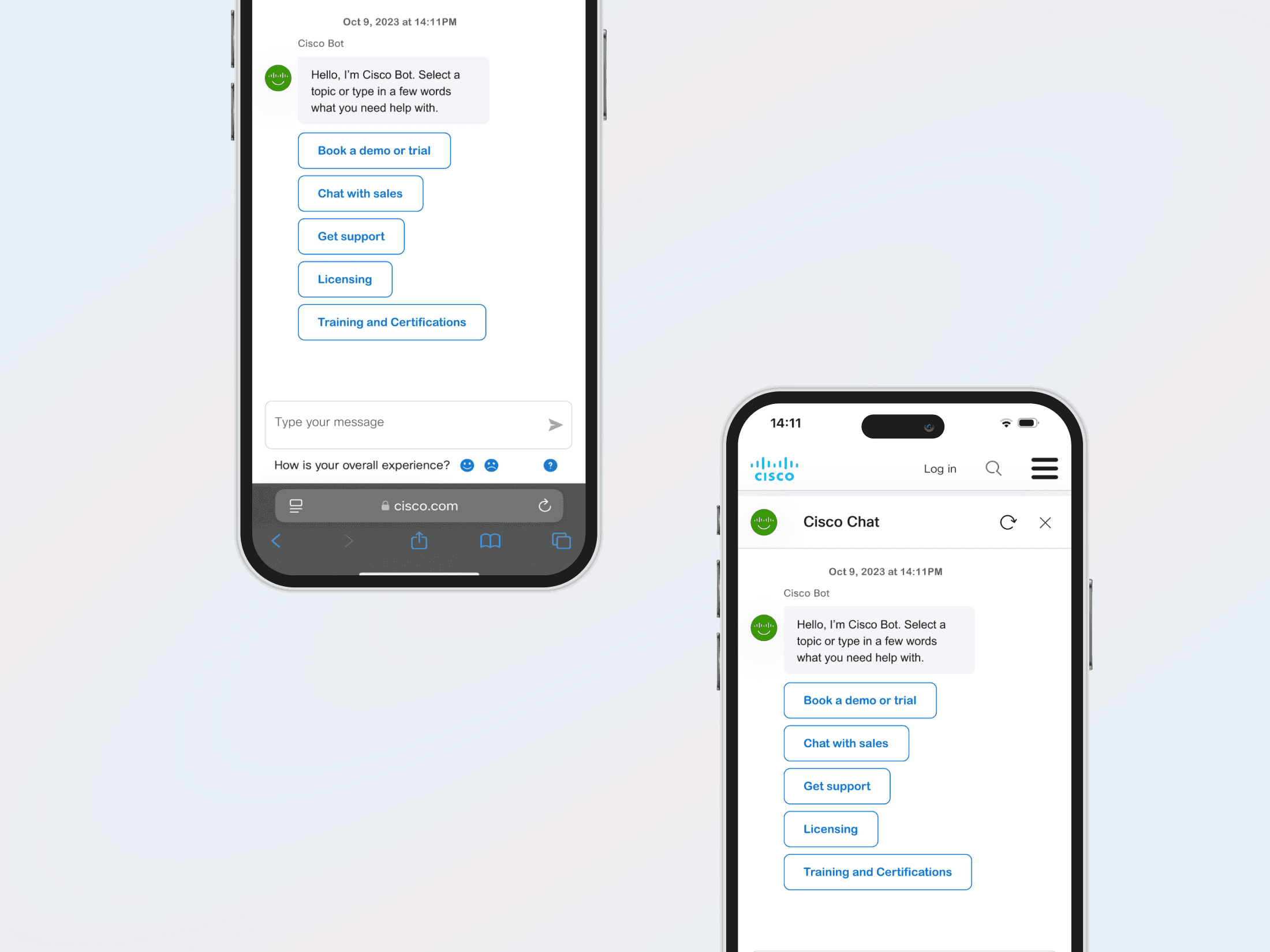
With stakeholder approval secured, I moved into execution. The existing chatbot overwhelmed users with unnecessary paths and options — so I stripped the architecture down to core categories based on research insights, creating focused chat journeys that matched how users actually think and what they actually needed. Fewer paths meant less cognitive load, and a bot that felt predictable built the trust the previous experience had eroded.
Scope Limitation
Generative AI
Promotions
Recommendations
EXPERIENCE FOCUSED
Align to Muse design system
Restructure domains and intents
Enhance conversational script
Re-Architecting the Journey
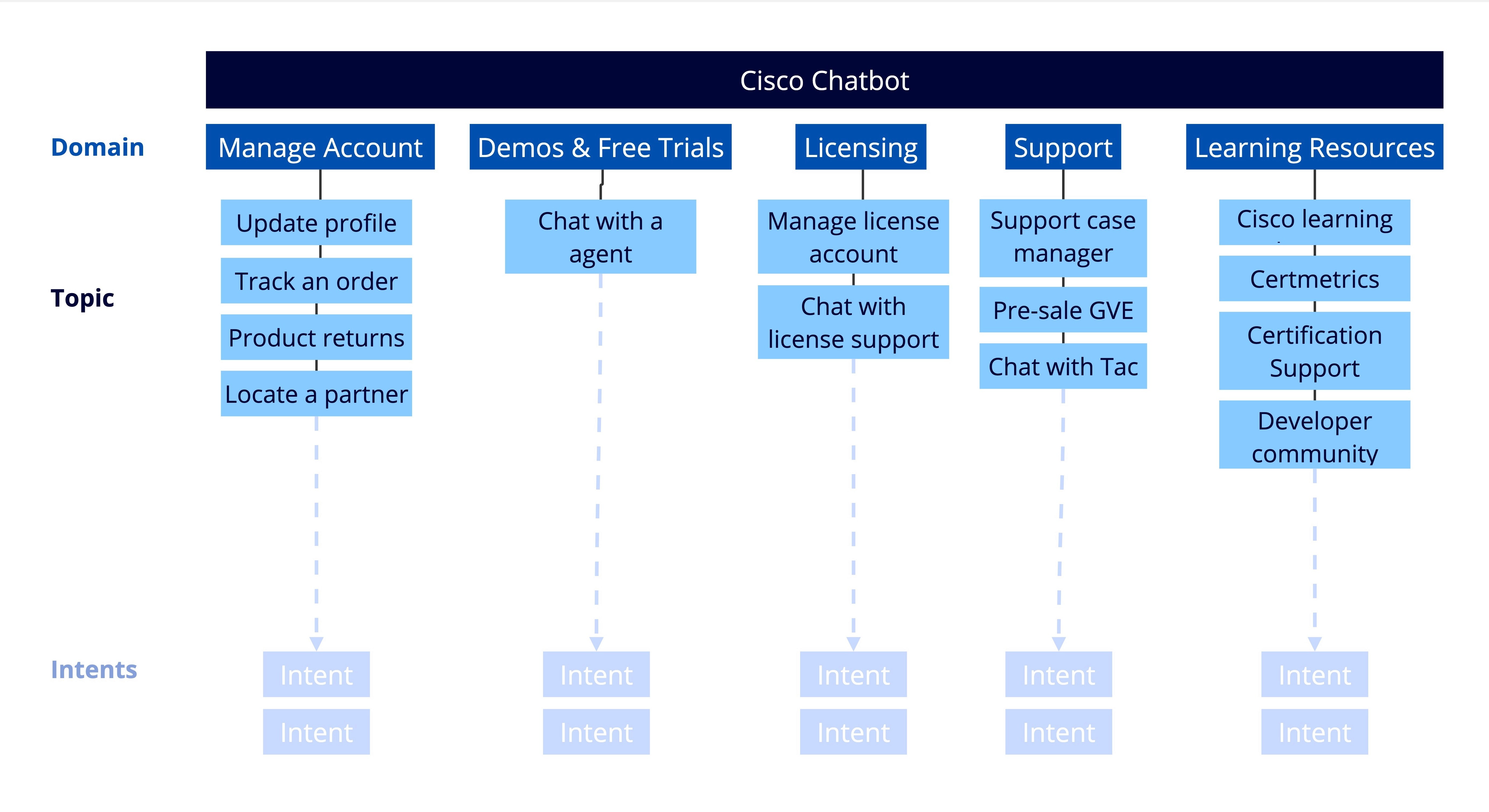
With stakeholder alignment secured. I stripped away the chaotic legacy architecture based on research insights, I consolidated the system into core conversational categories that mapped directly to real user mental models.
On the business side, this streamlined IA shred a dual purpose: it maximized self-service by users while strategically routing high-intent queries to sales agents at the moment of need. The result served the user without friction.
Living User Flows: Created dynamic, scenario-driven conversation flows tied to validated chatbot domains. These weren't static deliverables, they served as living blueprints that evolved alongside technical discoveries.
Cross Functional Co-Design: Led collaboration workshops with engineering and product management to answer one core question: How might we optimize the chatbot experience within our technical constraints?
De-Risking via Validation: Tested and validated the taxonomy with real users ensuring the structure held up against actual behavior rather than assumptions.
This process ensured
User journeys were validated against real behavior
Technical constraints were surfaced early, not at handoff
Business value and user impact were balanced at every decision point
Engineering received clear, unambiguous handoff
Shaping The Interface
Because the Muse Design System lacked conversational components, I strategically re-purposed existing web components. This preserved brand consistency without forcing the teams to build new components libraries from scratch.
Live Validation and Critical Realization
Rapid Component Mapping: Started with low-fidelity wireframes to quickly visualize conversational layout, identifying structural UI.
Live Testing: High-fidelity prototype tested at Cisco Live for quick validation, serving real enterprise customers interacting with the chatbot in real time.
Uncovering the Real Mental Model: The live testing surprised our assumptions. Customers explicitly wanted true contextual intelligence. Not surface level personalization.
Data- Driven Refinement: This critical insight validated my earlier decision to prioritize a robust conversational taxonomy.
Impact
50 Days Post-Launch: The revamped conversational architecture proved that grounding design in user logic rather than technology trends yields business returns. By replacing the rigid decision tree with focused chat journeys compliant with the Muse Design System builds user trust and minimized friction.
13.5%
Increased CTR
34%
Increased user engagement
40%
Improved chat journeys
Reflection
This project reinforced a critical product reality: implementing features for the sake of emerging technology is a risk, not a design strategy.
Recognizing early that the infrastructure wasn't ready for Generative AI was the right call. The most pragmatic, valuable move was to architect a scalable foundation that earns user trust first. As the lead designer, staying deeply embedded with cross- functional teams allowed me to communicate effectively, keeping our execution grounded in human judgment and real constraints rather than hype.
Next Steps
Continuous Measurement: Partner with the research to run post-launch usability benchmarking and track experience quality metrics.
Contextual Personalization: Explore next phase of smart, personalized chat logic moving beyond basic name insertion.
AI Design Standards: Collaborate with the design system team to define, test, and establish AI interaction patterns for future implementation.
Because the Muse Design System lacked conversational components, I strategically re-purposed existing web components. This preserved brand consistency without forcing the teams to build new components libraries from scratch.
Live Validation and Critical Realization
Rapid Component Mapping: Started with low-fidelity wireframes to quickly visualize conversational layout, identifying structural UI.
Live Testing: High-fidelity prototype tested at Cisco Live for quick validation, serving real enterprise customers interacting with the chatbot in real time.
Uncovering the Real Mental Model: The live testing surprised our assumptions. Customers explicitly wanted true contextual intelligence. Not surface level personalization.
Data- Driven Refinement: This critical insight validated my earlier decision to prioritize a robust conversational taxonomy.
Impact
50 Days Post-Launch: The revamped conversational architecture proved that grounding design in user logic rather than technology trends yields business returns. By replacing the rigid decision tree with focused chat journeys compliant with the Muse Design System builds user trust and minimized friction.
13.5%
Increased Click-through rate
34%
Increased user engagement
40%
Improved chat journeys
13.5%
Increased CTR
34%
Increased user engagement
40%
Improved chat journeys
Reflection
This project reinforced a critical product reality: implementing features for the sake of emerging technology is a risk, not a design strategy.
Recognizing early that the infrastructure wasn't ready for Generative AI was the right call. The most pragmatic, valuable move was to architect a scalable foundation that earns user trust first. As the lead designer, staying deeply embedded with cross- functional teams allowed me to communicate effectively, keeping our execution grounded in human judgment and real constraints rather than hype.
Next Steps
Continuous Measurement: Partner with the research to run post-launch usability benchmarking and track experience quality metrics.
Contextual Personalization: Explore next phase of smart, personalized chat logic moving beyond basic name insertion.
AI Design Standards: Collaborate with the design system team to define, test, and establish AI interaction patterns for future implementation.