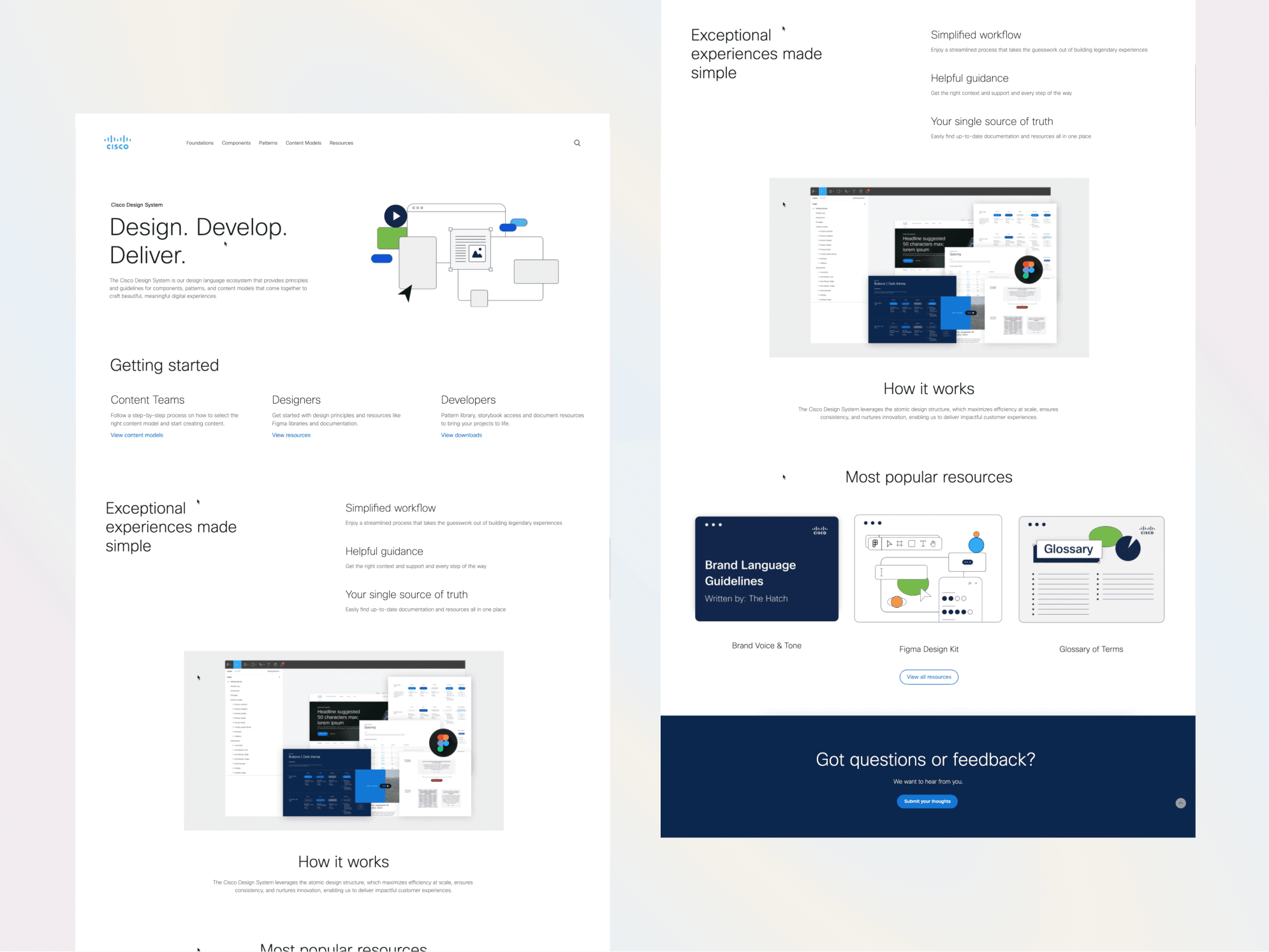
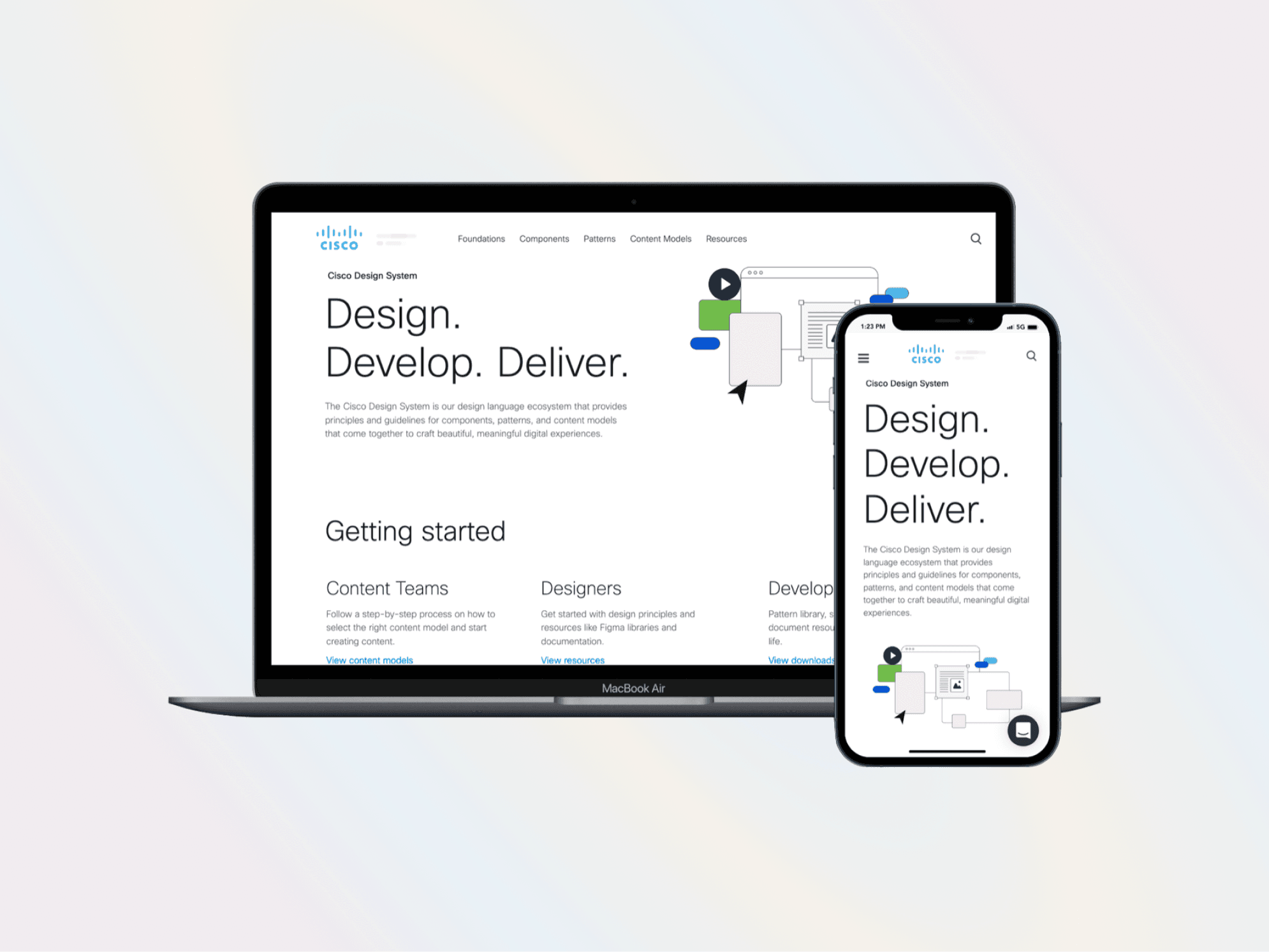
Muse Reference Site
Muse Reference Site
Muse Reference Site
Empowering teams to scale, 50% growth in registration
Empowering teams to scale, 50% growth in registration
ROLE
UX Designer
DOMAIN
Enterprise Product Design, Employee Experience, DesignOps
TEAM
Digital Studio, Design System, Research, Engineering, Content, and Publishing Teams. Business Leaders, and Accenture
TIMELINE
April 2021- October 2022
Digital Studio, Design System, Research, Engineering, Content, and Publishing Teams. Business Leaders, and Accenture
ROLE
UX Designer
DOMAIN
Enterprise Product Design, Employee Experience, DesignOps
TEAM
TIMELINE
April 2021- October 2022
ROLE
UX Designer
DOMAIN
Enterprise Product Design, Employee Experience, DesignOps
TIMELINE
April 2021- October 2022
TEAM
Digital Studio, Design System, Research, Engineering, Content, and Publishing Teams. Business Leaders, and Accenture
Overview
Overview
Overview
Cisco was in the midst of a massive transformation, overhauling its entire global digital presence with a complete rebrand and new Muse design system.
Cisco was in the midst of a massive transformation, overhauling its entire global digital presence with a complete rebrand and new Muse design system.
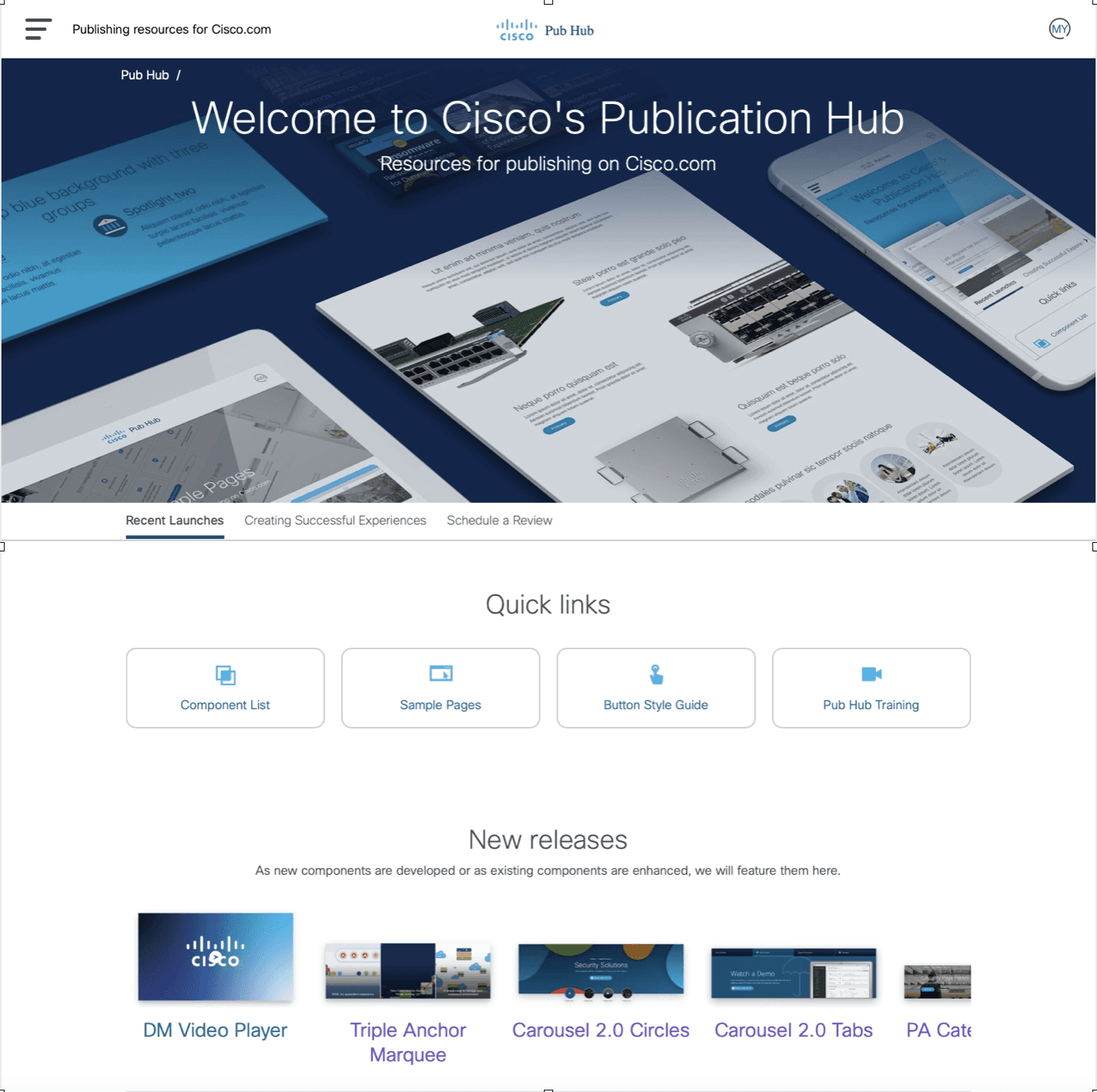
Teams, vendors, and business units needed to scale content creation and adopt Muse quickly, but the legacy Publication Hub (Pub Hub) had become a barrier. It was outdated, misaligned with the rebrand, and provided no clear guidance. This resulted in inconsistent experiences, inefficiencies, and confusion across teams.
Leadership needed a reference site that would become the single source of truth for the Muse design system, enabling internal teams to create and publish pages confidently at scale. I led end-to-end UX and DesignOps to create the organization's first comprehensive reference site.
Teams, vendors, and business units needed to scale content creation and adopt Muse quickly, but the legacy Publication Hub (Pub Hub) had become a barrier. It was outdated, misaligned with the rebrand, and provided no clear guidance. This resulted in inconsistent experiences, inefficiencies, and confusion across teams.
Leadership needed a reference site that would become the single source of truth for the Muse design system, enabling internal teams to create and publish pages confidently at scale. I led end-to-end UX and DesignOps to create the organization’s first comprehensive reference site.
Goal
Goal
Goal
Create a centralized Reference Site to sunset Publication Hub and establish a single source of truth for the Muse Design System
Objectives
Empower internal teams to create and publish pages quickly and confidently
Scale publishing independently across departments
Accelerate Muse design system adoption
Constraints
No existing reference site foundation to build from
Development resources stretched across multiple priorities
Aggressive timeline to support the broader .com transformation
Create a centralized Reference Site to sunset Publication Hub and establish a single source of truth for the Muse Design System
Objectives
Empower internal teams to create and publish pages quickly and confidently
Scale publishing independently across departments
Accelerate Muse design system adoption
Constraints
No existing reference site foundation to build from
Development resources stretched across multiple priorities
Aggressive timeline to support the broader .com transformation
Jump to Solution
"There's too many places for resources and documentation, most are outdated."
"There's too many places for resources and documentation, most are outdated."
—Cisco Employee
Enterprise Discovery
Enterprise Discovery
Enterprise Discovery
Stepping in to lead this platform migration from the ground up, I shifted our approach from relying on legacy assumptions to conducting targeted, moderated interviews with internal cross-functional teams. Because Pub Hub and divergent resources were misaligned with our rebranded Muse Design System, I needed to understand how teams actually operationalized design and content standards at scale. Discovery revealed:
Stepping in to lead this platform migration from the ground up, I shifted our approach from relying on legacy assumptions to conducting targeted, moderated interviews with internal cross-functional teams. Because Pub Hub and divergent resources were misaligned with our rebranded Muse Design System, I needed to understand how teams actually operationalized design and content standards at scale. Discovery revealed:
Through moderated interviews, I identified four distinct user archetypes across the ecosystem (Business Units, Designers, Publishers, and Site Strategist) . Our power user was the Site Strategist, the architect responsible for driving daily page creation, mapping content models, and validating pattern compliance under tight production deadlines.
Limited knowledge of
design systems
Not aligned with
current requirements
Confusing and
convoluted workflow
Limited knowledge of
design systems
Not aligned with
current requirements
Confusing and
convoluted workflow
Limited knowledge
of design systems
Not aligned with
current requirements
Confusing and
convoluted workflow
Through moderated interviews, I identified four distinct user archetypes across the ecosystem (Business Units, Designers, Publishers, and Site Strategist) . Our power user was the Site Strategist, the architect responsible for driving daily page creation, mapping content models, and validating pattern compliance under tight production deadlines.
Through moderated interviews, I identified four distinct user archetypes across the ecosystem (Business Units, Designers, Publishers, and Site Strategist) . Our power user was the Site Strategist, the architect responsible for driving daily page creation, mapping content models, and validating pattern compliance under tight production deadlines.


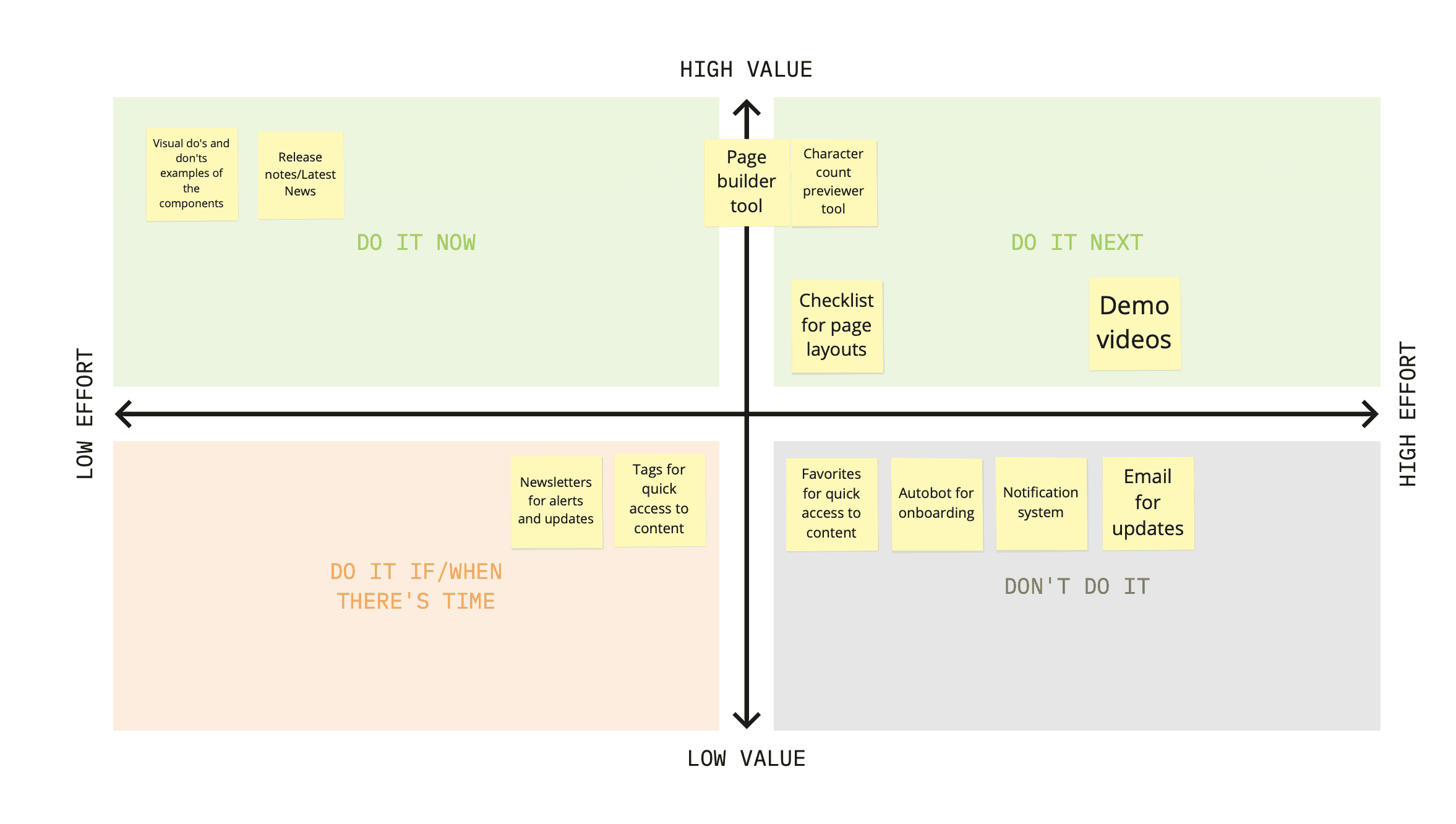
MVP Prioritization
To prevent scope creep and align disparate internal teams, I facilitated cross-functional workshops across engineering, product stakeholders, and core design teams. I mapped out the friction points and locked down an intersection of MVP Priorities designed to accelerate time-to-market.
Prescriptive Content Models: Definitive authoring documentation, including mandatory character counts and structure logic, to standardize data entry.
UX Component Guardrails: Explicit logic rules detailing exactly how, when, and where to deploy specific Muse components versus legacy patterns.
Interactive & Visual Architecture: High-fidelity visual examples coupled with live, production-site implementations for real-world engineering context.
System Compliance Metrics: Concrete “Do’s and Don’ts” to eliminate design debt and prevent unauthorized, one-off legacy patterns.
With cross-functional alignment secured and our MVP taxonomy defined, I prepared to move the team into rapid ideation—until we hit a major structural roadblock.

Build or Buy-In
With MVP priorities locked, I faced an immediate technical constraint: our engineering team had zero capacity to custom-build a dedicated documentation site. To preserve our launch timeline, I pivoted from custom architecture to a “Buy vs. Build” strategy.
I facilitated technical working sessions with engineering leads to define backend requirements and benchmark third-party front-end platforms. Based on this technical evaluation, I recommended Frontify as our enterprise hosting solution and successfully secured executive budget approval.
Frontify Evaluation Matrix
Figma Integration: Native, seamless synchronization to eliminate manual design-to-code handoff debt.
Out-of-the-Box Fit: Met 90% of our MVP requirements natively on day one.
Scalable Customization: Flexible underlying logic to support future, complex design system iterations.
Enterprise Compliance: Fulfilled Cisco’s strict global security, legal, and compliance guardrails.


The Strategic Pivot: Shifting to DesignOps Execution
Procuring a new enterprise platform had consumed valuable calendar time. To compress our delivery cycle, I initiated a radical operational pivot: bypassing traditional prototyping entirely to design and build directly within the live Frontify platform.
Securing immediate cross-functional buy-in shifted my role from a traditional UX lead into a hybrid UX/DesignOps capacity, simultaneously architecting the ecosystem and executing the production-ready site.
What I Directed & Executed
Information Architecture: Structured and validated the global platform taxonomy through rigorous card sorting sessions conducted in collaboration with research.
Content & Structure Logic: Establish page hierarchies, text guardrails, and asset organization rules.
Visual System Adaptation: Coordinated with UI and visual design peers to ensure every layout aligned perfectly with the new Muse Design System.
Phased Launch Prioritization: Sequenced sectional deployments strategically by cross-referencing core Site Strategist needs with immediate business value milestones.
End-to-End Validation: Led targeted usability testing in production to refine layouts prior to the live enterprise launch.
Impact
Within 30 days, the Muse Reference Site fundamentally altered Cisco’s internal velocity. By successfully sunsetting the fragmented legacy Publication Hub, there was a unified source of truth for all teams creating digital experiences on Cisco.com.
93%
Increased adoption rate
100%
Work efficiency
50%
Increased user registration
What Was Launched
6 Content Models: Complete structured templates with prescriptive authoring and governance
18 Pattern Pages: Documented reusable building block with explicit usage guidelines and best practices
Established the Learning Center to train internal teams on site usage
Scaling the Ecosystem
Launching the platform was foundational, driving sustained adoption and trust required active governance.
I partnered with our Creative Design System Leader to architect an ongoing cross- functional support ecosystem to sustain and scale the reference site independently.
Real-Time Office Hours: Co-led weekly interactive design office hours to provide internal teams with contextual pattern guidance and troubleshooting
Contribution Framework: Established clear contribution guidelines to empower teams to contribute or recommend enhancements of the design system.
Enterprise Self Service: Established educational assets and resources to reduce operational friction and empower teams to execute within compliance and confidence.
MVP Prioritization
MVP Prioritization
To prevent scope creep and align disparate internal teams, I facilitated cross-functional workshops across engineering, product stakeholders, and core design teams. I mapped out the friction points and locked down an intersection of MVP Priorities designed to accelerate time-to-market.
To prevent scope creep and align disparate internal teams, I facilitated cross-functional workshops across engineering, product stakeholders, and core design teams. I mapped out the friction points and locked down an intersection of MVP Priorities designed to accelerate time-to-market.
Prescriptive Content Models: Definitive authoring documentation, including mandatory character counts and structure logic, to standardize data entry.
UX Component Guardrails: Explicit logic rules detailing exactly how, when, and where to deploy specific Muse components versus legacy patterns.
Interactive & Visual Architecture: High-fidelity visual examples coupled with live, production-site implementations for real-world engineering context.
System Compliance Metrics: Concrete "Do's and Don'ts" to eliminate design debt and prevent unauthorized, one-off legacy patterns.
With cross-functional alignment secured and our MVP taxonomy defined, I prepared to move the team into rapid ideation, until we hit a major structural roadblock.
Prescriptive Content Models: Definitive authoring documentation, including mandatory character counts and structure logic, to standardize data entry.
UX Component Guardrails: Explicit logic rules detailing exactly how, when, and where to deploy specific Muse components versus legacy patterns.
Interactive & Visual Architecture: High-fidelity visual examples coupled with live, production-site implementations for real-world engineering context.
System Compliance Metrics: Concrete “Do’s and Don’ts” to eliminate design debt and prevent unauthorized, one-off legacy patterns.
With cross-functional alignment secured and our MVP taxonomy defined, I prepared to move the team into rapid ideation—until we hit a major structural roadblock.
Build or Buy-In
Build or Buy-In
With MVP priorities locked, I faced an immediate technical constraint: our engineering team had zero capacity to custom-build a dedicated documentation site. To preserve our launch timeline, I pivoted from custom architecture to a "Buy vs. Build" strategy.
With MVP priorities locked, I faced an immediate technical constraint: our engineering team had zero capacity to custom-build a dedicated documentation site. To preserve our launch timeline, I pivoted from custom architecture to a “Buy vs. Build” strategy.
I facilitated technical working sessions with engineering leads to define backend requirements and benchmark third-party front-end platforms. Based on this technical evaluation, I recommended Frontify as our enterprise hosting solution and successfully secured executive budget approval.
I facilitated technical working sessions with engineering leads to define backend requirements and benchmark third-party front-end platforms. Based on this technical evaluation, I recommended Frontify as our enterprise hosting solution and successfully secured executive budget approval.
Frontify Evaluation Matrix
Figma Integration: Native, seamless synchronization to eliminate manual design-to-code handoff debt.
Out-of-the-Box Fit: Met 90% of our MVP requirements natively on day one.
Scalable Customization: Flexible underlying logic to support future, complex design system iterations.
Enterprise Compliance: Fulfilled Cisco’s strict global security, legal, and compliance guardrails.
Frontify Evaluation Matrix
Figma Integration: Native, seamless synchronization to eliminate manual design-to-code handoff debt.
Out-of-the-Box Fit: Met 90% of our MVP requirements natively on day one.
Scalable Customization: Flexible underlying logic to support future, complex design system iterations.
Enterprise Compliance: Fulfilled Cisco’s strict global security, legal, and compliance guardrails.
The Strategic Pivot: Shifting to DesignOps Execution
The Strategic Pivot: Shifting to DesignOps Execution
Procuring a new enterprise platform had consumed valuable calendar time. To compress our delivery cycle, I initiated a radical operational pivot: bypassing traditional high-fidelity mockups to design and build directly within the live Frontify platform.
Securing immediate cross-functional buy-in shifted my role from a traditional UX Lead into a hybrid UX/DesignOps capacity, simultaneously architecting and executing the production-ready site.
Procuring a new enterprise platform had consumed valuable calendar time. To compress our delivery cycle, I initiated a radical operational pivot: bypassing traditional high-fidelity mockups to design and build directly within the live Frontify platform.
Securing immediate cross-functional buy-in shifted my role from a traditional UX Lead into a hybrid UX/DesignOps capacity, simultaneously architecting and executing the production-ready site.
What I Directed & Executed
What I Directed & Executed
Information Architecture: Structured and validated the global platform taxonomy through rigorous card sorting sessions conducted in collaboration with research.
Content & Structure Logic: Establish page hierarchies, text guardrails, and asset organization rules.
Visual System Adaptation: Coordinated with UI and visual design peers to ensure every layout aligned perfectly with the new Muse Design System.
Phased Launch Prioritization: Sequenced sectional deployments strategically by cross-referencing core Site Strategist needs with immediate business value milestones.
End-to-End Validation: Led targeted usability testing in production to refine layouts prior to the live enterprise launch.
Information Architecture: Structured and validated the global platform taxonomy through rigorous card sorting sessions conducted in collaboration with research.
Content & Structure Logic: Establish page hierarchies, text guardrails, and asset organization rules.
Visual System Adaptation: Coordinated with UI and visual design peers to ensure every layout aligned perfectly with the new Muse Design System.
Phased Launch Prioritization: Sequenced sectional deployments strategically by cross-referencing core Site Strategist needs with immediate business value milestones.
End-to-End Validation: Led targeted usability testing in production to refine layouts prior to the live enterprise launch.
Impact
Impact
Within 30 days, the Muse Reference Site fundamentally altered Cisco’s internal velocity. By successfully sunsetting the fragmented legacy Publication Hub, there was a unified source of truth for all teams creating digital experiences on Cisco.com.
Within 30 days, the Muse Reference Site fundamentally altered Cisco’s internal velocity. By successfully sunsetting the fragmented legacy Publication Hub, there was a unified source of truth for all teams creating digital experiences on Cisco.com.
93%
Increased adoption rate
100%
Work efficiency
50%
Increased user registration
What Was Launched
6 Content Models: Complete structured templates with prescriptive authoring and governance
18 Pattern Pages: Documented reusable building block with explicit usage guidelines and best practices
Established the Learning Center to train internal teams on site usage
What Was Launched
6 Content Models: Complete structured templates with prescriptive authoring and governance
18 Pattern Pages: Documented reusable building block with explicit usage guidelines and best practices
Established the Learning Center to train internal teams on site usage
Scaling the Ecosystem
Scaling the Ecosystem
Launching the platform was foundational, driving sustained adoption and trust required active governance.
Launching the platform was foundational, driving sustained adoption and trust required active governance.
I partnered with our Creative Design System Leader to architect an ongoing cross- functional support ecosystem to sustain and scale the reference site independently.
Real-Time Office Hours: Co-led weekly interactive design office hours to provide internal teams with contextual pattern guidance and troubleshooting
Contribution Framework: Established clear contribution guidelines to empower teams to contribute or recommend enhancements of the design system.
Enterprise Self Service: Established educational assets and resources to reduce operational friction and empower teams to execute within compliance and confidence.
I partnered with our Creative Design System Leader to architect an ongoing cross- functional support ecosystem to sustain and scale the reference site independently.
Real-Time Office Hours: Co-led weekly interactive design office hours to provide internal teams with contextual pattern guidance and troubleshooting
Contribution Framework: Established clear contribution guidelines to empower teams to contribute or recommend enhancements of the design system.
Enterprise Self Service: Established educational assets and resources to reduce operational friction and empower teams to execute within compliance and confidence.
Reflection
Navigating this enterprise migration reinforced that a design system reference site is not just a documentation tool, it’s an organizational change initiative. Success depended entirely on building proactive trust with cross-functional teams to champion and adopt the Muse system daily.
Furthermore, architecting for four distinct user archetypes underscored the critical, codependent relationship between Information Architecture and Content Strategy. An enterprise platform can feature flawless navigation, but if the underlying content models fail to respect the precise contextual constraints of power users like Site Strategists, adoption will stall. Enterprise design must be rooted in operational utility, not just visual alignment.
Reflection
Reflection
Navigating this enterprise migration reinforced that a design system reference site is not just a documentation tool, it's an organizational change initiative. Success depended entirely on building proactive trust with cross-functional teams to champion and adopt the Muse system daily.
Navigating this enterprise migration reinforced that a design system reference site is not just a documentation tool, it’s an organizational change initiative. Success depended entirely on building proactive trust with cross-functional teams to champion and adopt the Muse system daily.
Furthermore, architecting for four distinct user archetypes underscored the critical, codependent relationship between Information Architecture and Content Strategy. An enterprise platform can feature flawless navigation, but if the underlying content models fail to respect the precise contextual constraints of power users like Site Strategists, adoption will stall. Enterprise design must be rooted in operational utility, not just visual alignment.
Furthermore, architecting for four distinct user archetypes underscored the critical, codependent relationship between Information Architecture and Content Strategy. An enterprise platform can feature flawless navigation, but if the underlying content models fail to respect the precise contextual constraints of power users like Site Strategists, adoption will stall. Enterprise design must be rooted in operational utility, not just visual alignment.